High-Performance Narrowband Optical Filters: Precision Thin-Film Coatings for Demanding Applications
Narrowband optical filters isolate a precisely defined wavelength band from a much broader optical background, delivering higher signal-to-noise ratios and selective detection of weak optical signals. In this edition we show how I-Photonics engineers complex PARMS interference coatings — over one hundred dielectric layers — and demonstrate an astronomy-grade [S II] narrowband filter near 673.1 nm with 93.89% peak transmission and a ~3.1 nm FWHM.

Narrowband optical filters are essential wherever a specific spectral signal must be isolated from a much broader optical background. By transmitting only a precisely defined wavelength range while strongly suppressing adjacent and out-of-band radiation, these filters enable higher signal-to-noise ratios, improved measurement accuracy, and selective detection of weak optical signals.
Applications for narrowband filters extend across a wide range of industries and scientific fields, including spectroscopy, fluorescence imaging, laser systems, environmental and gas sensing, machine vision, biomedical instrumentation, scientific research, space instrumentation, and astronomy. While the spectral requirements differ from one application to another, the underlying technological challenge remains the same: achieving a narrow and accurately positioned transmission band together with high peak transmission, steep spectral edges, deep blocking, and long-term coating stability.
Engineering Narrow Spectral Filters
As filter bandwidth decreases, manufacturing complexity increases significantly. A high-performance narrowband filter may require well over one hundred individual dielectric layers, each of which must be deposited with extremely high thickness accuracy.
Even small deviations accumulated through the multilayer structure can cause:
- a shift of the central wavelength;
- broadening or distortion of the passband;
- reduction of peak transmission;
- insufficient out-of-band blocking;
- spectral non-uniformity across the coated area.
At the same time, increasing the number of layers increases the total coating thickness and makes mechanical stress management increasingly important. The deposition process must maintain both optical precision and mechanical stability to avoid cracking, delamination, substrate deformation, or changes in spectral performance.
For this reason, manufacturing advanced narrowband filters is not simply a matter of having a sophisticated optical design. The design, coating materials, deposition technology, optical monitoring strategy, and process stability must operate as a single system.
I-Photonics Narrowband Coating Capability
I-Photonics develops complex interference coatings using its Meridian PARMS vacuum coating platform. The technology combines reactive magnetron sputtering with plasma assistance, enabling the deposition of dense dielectric layers with stable optical properties and low optical losses.
High-index and low-index dielectric materials can be combined into complex multilayer stacks engineered for specific spectral requirements. The high refractive-index contrast achievable with materials such as Nb₂O₅ and SiO₂ supports the creation of narrow transmission windows, steep spectral transitions, high in-band transmission, and strong blocking outside the required spectral region.
Continuous optical monitoring during deposition provides precise control over individual layers throughout long and complex coating processes. This becomes particularly important for narrowband filters, where the final spectral response depends on the cumulative accuracy of the entire multilayer structure.
Equally important is coating uniformity. A narrow passband can shift noticeably with relatively small variations in coating thickness. Therefore, maintaining high thickness uniformity across the substrate or coating holder is essential for achieving consistent spectral characteristics across the usable optical aperture and from component to component.
From Spectral Requirement to Manufacturable Filter
The I-Photonics approach begins with the required optical performance rather than with a predefined coating structure.
Depending on the application, a narrowband filter can be engineered around parameters such as:
- center wavelength;
- full width at half maximum (FWHM);
- peak transmission;
- blocking range and optical density;
- angle of incidence;
- polarization requirements;
- substrate material and geometry;
- environmental and durability requirements.
The optical design is then translated into a deposition process using the actual optical properties of the coating materials and the capabilities of the production system. This connection between design and real deposition conditions is particularly important for complex filters, where theoretical performance alone does not guarantee a manufacturable and repeatable product.
Astronomy as a Demanding Example
Astronomy is one application where the advantages of narrowband filtering are especially visible. Many astronomical objects emit radiation at specific wavelengths associated with atomic and ionic transitions. Narrowband filters allow these weak emission lines to be separated from the surrounding spectral background, increasing contrast and revealing structures that can be difficult to observe through broadband imaging.
Important astronomical bands include Hα, [O III], [S II], and other wavelength regions selected according to the object and observation method.
A recent I-Photonics development focused on the ionized sulfur [S II] line near 673.1 nm, which is used in observations of emission nebulae, shock-excited gas, supernova remnants, and other structures in the interstellar medium.
The target was to produce an [S II] narrowband filter with a less than 4 nm FWHM, maximizing transmission within the passband while providing effective rejection of unwanted wavelengths.
Achieving this spectral response required a sophisticated thin-film design comprising approximately 170 dielectric layers, with a total physical coating thickness of around 20 µm.
Such a structure represents a demanding test of narrowband coating technology. Layer thicknesses must remain precisely controlled throughout the entire stack, while accumulated mechanical stress must be managed over a coating tens of micrometers thick. At the same time, deposition conditions must remain stable for an extended period to prevent spectral drift during the process.
The complete coating was deposited on the Meridian system in a continuous vacuum cycle of approximately 48 hours, with optical monitoring throughout the multilayer deposition.
Final spectrophotometric measurements demonstrated a peak transmission of 93.89% and a measured FWHM of approximately 3.1 nm.
These results demonstrate the ability to combine very high transmission with an extremely narrow spectral window in a complex multilayer optical coating.
Beyond Astronomy
While the [S II] filter provides a clear demonstration of the technology, the underlying capability is not limited to astronomical applications.
The same principles can be applied wherever a narrow optical signal needs to be separated from background radiation or neighboring spectral features. Depending on the required wavelength range and operating conditions, narrowband coating technology can support applications in spectroscopy, fluorescence detection, analytical instrumentation, laser wavelength selection, optical sensing, machine vision, biomedical systems, environmental monitoring, and scientific instrumentation.
Each application places different demands on the filter. One system may prioritize maximum transmission at a specific laser wavelength, while another requires extremely steep blocking close to the passband. Other applications may require spectral stability over a defined angular range, high uniformity over a large aperture, or customized performance at several selected wavelengths.
This is where the ability to develop the entire multilayer structure around the customer's optical specification becomes particularly valuable.
From Complex Design to Repeatable Production
The [S II] project demonstrates more than the performance of one astronomical filter. A 170-layer, approximately 20 µm thick coating deposited continuously over 48 hours provides a practical validation of the process stability required for highly complex narrowband optical coatings.
By combining thin-film optical design, PARMS deposition, high-index-contrast dielectric materials, in-process optical monitoring, coating uniformity control, stress management, and final spectral characterization, I-Photonics can develop narrowband filters tailored to demanding optical requirements.
The result is a flexible technology platform for transforming a required spectral window into a manufacturable optical component—from initial design and prototype development to process validation and repeatable production.
Astronomical filters are one particularly demanding example. The broader capability is precision control of light within an exceptionally narrow spectral range.
Narrowband Optical Filters: Precision Thin-Film Coatings | I-Photonics Blog
Read more

When Every ppm Matters: The Science Behind Low Absorption Optical Coatings
At the frontier of high-power lasers and gravitational wave detection, optical losses are now measured in ppm. We explore how electric field engineering and thermal relaxation push IBS thin films into the single-digit ppm absorption regime, enabling HR mirrors with reflectance up to 99.9966%.
When Every ppm Matters: The Science Behind Low Absorption Optical Coatings | I-Photonics Blog
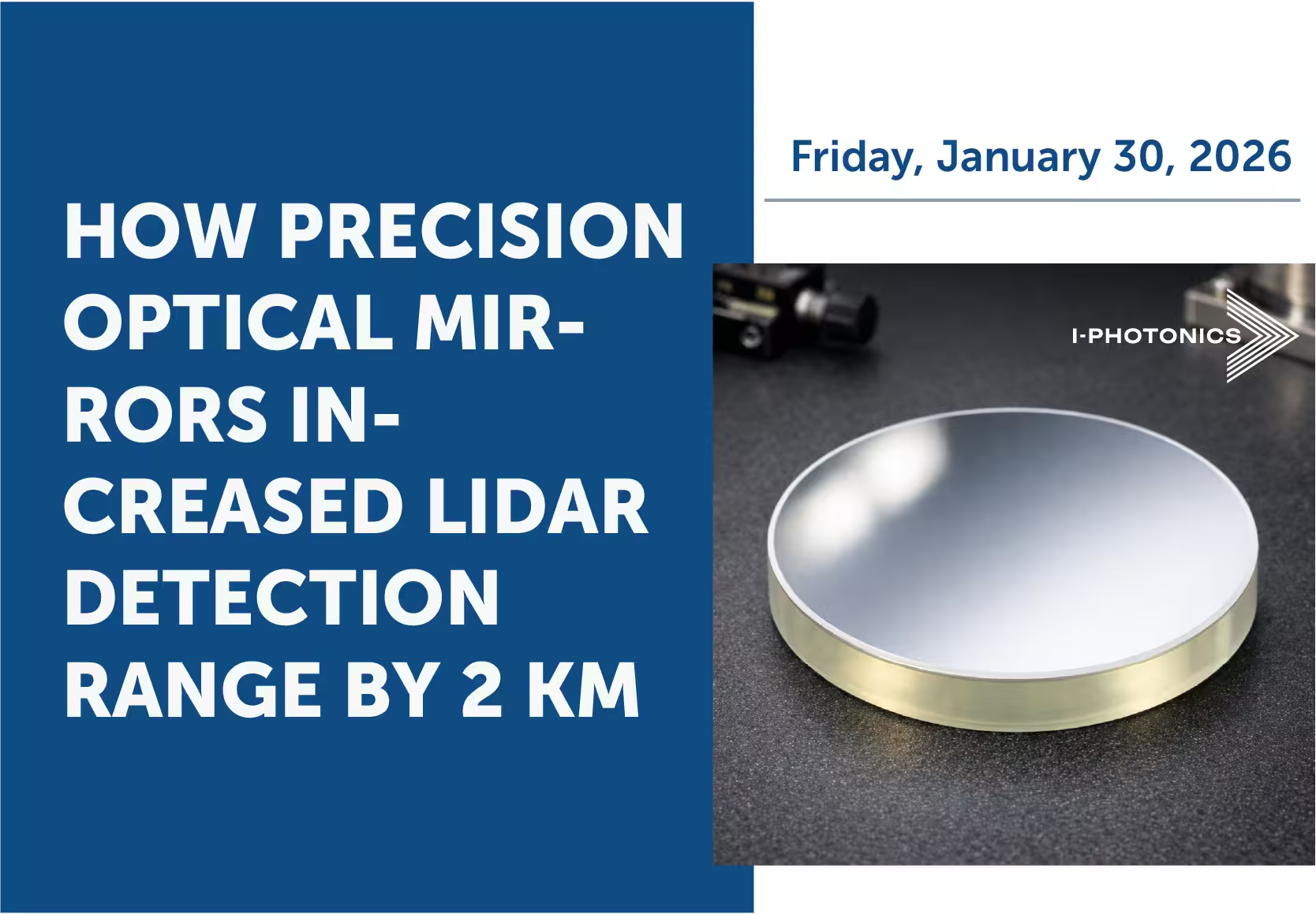
How Precision Optical Mirrors Increased LiDAR Detection Range by 2 km
How precision optics boosts 1550 nm LiDAR range and signal fidelity — a real 13% system improvement case study.
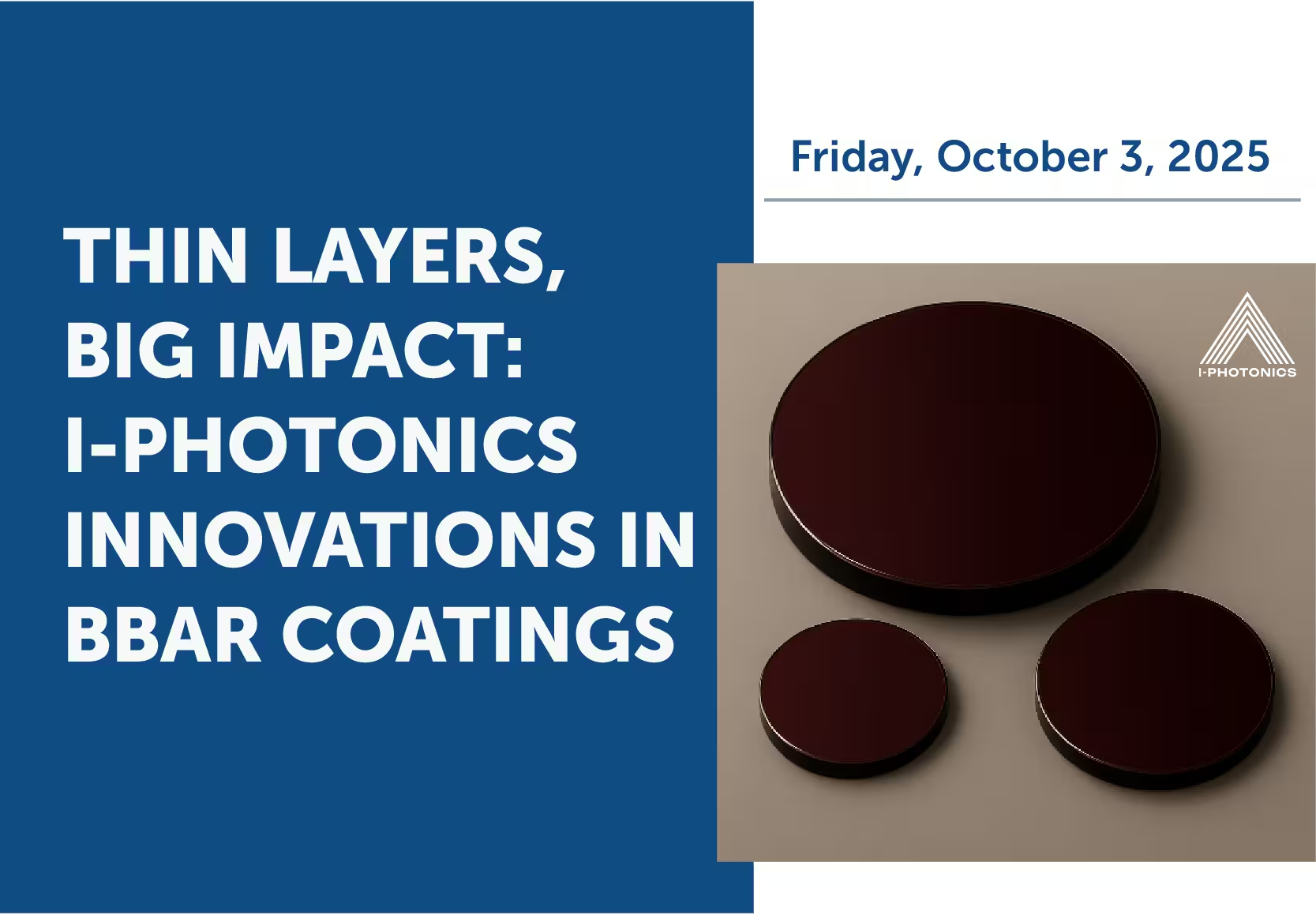
Thin Layers, Big Impact: I-Photonics Innovations in BBAR Coatings
In this edition, we highlight broadband anti-reflection (BBAR) coatings engineered for the critical 8–14 µm LWIR range. By minimizing surface reflections on ZnS and Ge optics, these multilayer coatings achieve transmission levels above 94–98%, unlocking higher sensitivity and performance in thermal imaging, laser systems, and IR sensors.
BBAR Coatings: Thin Layers, Big Impact on Optics | I-Photonics Blog