How Precision Optical Mirrors Increased LiDAR Detection Range by 2 km
How precision optics boosts 1550 nm LiDAR range and signal fidelity — a real 13% system improvement case study.
Component-Level Optimization with System-Level Impact
In long-range LiDAR systems, overall performance is often limited not by the laser source or detection electronics, but by the quality of the optical components within the system. A recent 1550 nm LiDAR implementation clearly demonstrates how precise optical engineering at the mirror level can significantly enhance system performance.
By optimizing a single optical elementa custom-designed 45° field-of-view mirror—the LiDAR system achieved a 13 % increase in detection range, extending from 15 km to 17 km. Notably, this improvement was realized without any modifications to the laser source or receiver electronics, underlining the critical role of high-precision optics in advanced photonic systems.
Mirror Design for Long-Range LiDAR Applications
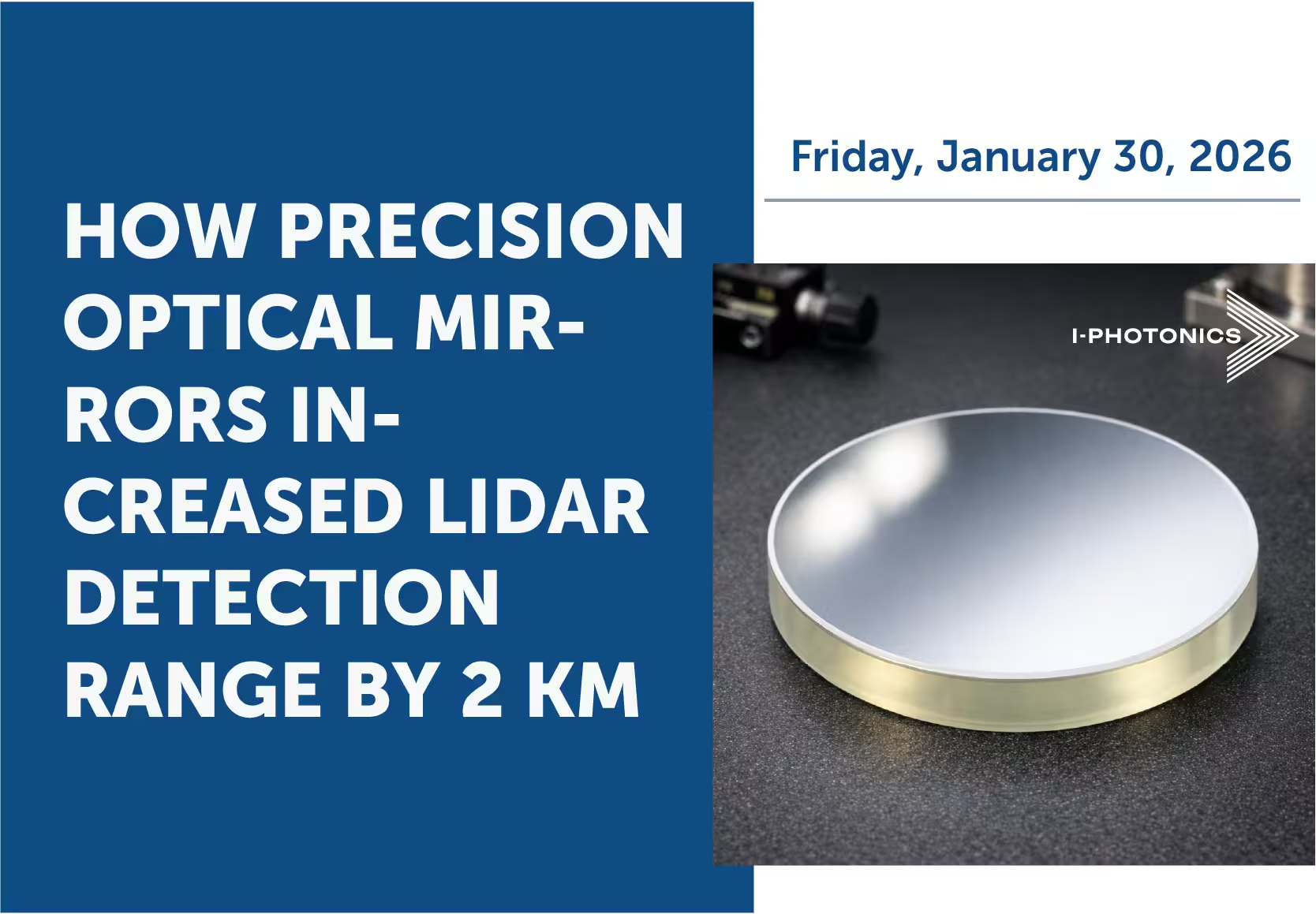
The mirror was fabricated using a Zerodur® substrate with a diameter of 200 mm and a thickness of 25 mm, selected for its exceptional thermal stability and mechanical rigidity. These properties are essential for maintaining optical alignment and wavefront quality in demanding operational environments.
To achieve ultra-high reflectivity at the target wavelength, a 6.6 µm multilayer dielectric coating was designed and applied. The coating delivers greater than 99.9 % reflectivity for both S- and P-polarizations at 1550 nm, while ensuring negligible phase difference (φₛ ≈ φₚ). This polarization-insensitive behavior is critical for preserving signal uniformity across the full aperture of the LiDAR system.
Stress Management and Optical Uniformity
Thick multilayer coatings on large-diameter optics can introduce mechanical stress, potentially leading to surface deformation and degraded optical performance. To address this, a stress-compensating layer was applied to the backside of the mirror. This approach minimizes substrate deformation and ensures consistent optical performance across the entire mirror surface.
Maintaining optical uniformity over the full aperture was a key factor in achieving the observed system-level performance improvement.
Advanced Coating Deposition with Ion Beam Sputtering
The multilayer coating was deposited using the Ion Beam Sputtering (IBS) technique with an assisted source. This method provides:
• Precise control of layer thickness and optical properties
• Reduced intrinsic coating stress
• Extremely low scattering losses
• High coating cleanliness (20-10 class)
These characteristics are essential for preserving wavefront quality and maximizing return signal strength in long-range LiDAR systems.
Measurable Performance Gains
The fabricated mirror exhibits ultra-high reflectivity, matched S/P phase, and minimal scattering at 1550 nm, resulting in a more uniform and higher-fidelity return signal. As a direct consequence, the LiDAR system achieved a measurable 2 km increase in detection range along with improved signal quality.
This case study demonstrates how precision optical design, advanced coating engineering, and controlled fabrication processes can significantly enhance overall system performance—without increasing system complexity.
Enabling Next-Generation Photonic Systems
At I-Photonics UAB, we specialize in the design and fabrication of high-performance optical components tailored for demanding applications such as LiDAR, remote sensing, and advanced photonic systems. This example highlights our ability to translate component-level innovation into tangible system-level benefits.
If you would like to discuss custom optical solutions for your application, please contact our team.
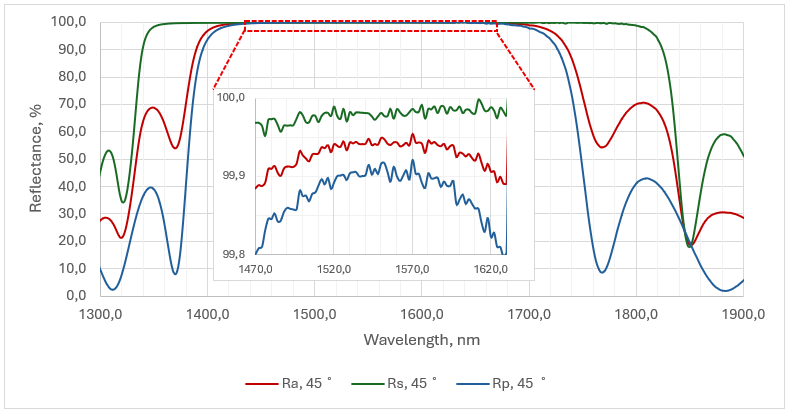
Pic. 1. Reflection curve for different polirization
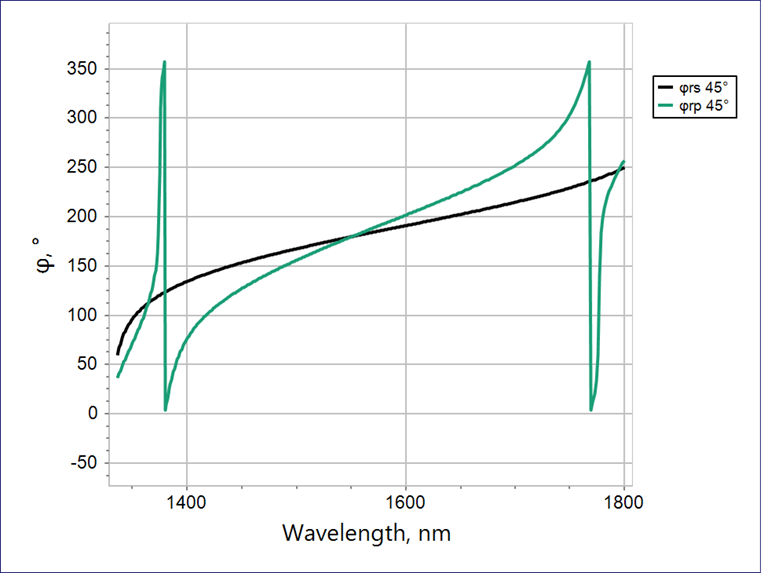
Pic. 2. Phase shift
Read more

High-Performance Narrowband Optical Filters: Precision Thin-Film Coatings for Demanding Applications
Narrowband optical filters isolate a precisely defined wavelength band from a much broader optical background, delivering higher signal-to-noise ratios and selective detection of weak optical signals. In this edition we show how I-Photonics engineers complex PARMS interference coatings — over one hundred dielectric layers — and demonstrate an astronomy-grade [S II] narrowband filter near 673.1 nm with 93.89% peak transmission and a ~3.1 nm FWHM.
Narrowband Optical Filters: Precision Thin-Film Coatings | I-Photonics Blog

When Every ppm Matters: The Science Behind Low Absorption Optical Coatings
At the frontier of high-power lasers and gravitational wave detection, optical losses are now measured in ppm. We explore how electric field engineering and thermal relaxation push IBS thin films into the single-digit ppm absorption regime, enabling HR mirrors with reflectance up to 99.9966%.
When Every ppm Matters: The Science Behind Low Absorption Optical Coatings | I-Photonics Blog
Thin Layers, Big Impact: I-Photonics Innovations in BBAR Coatings
In this edition, we highlight broadband anti-reflection (BBAR) coatings engineered for the critical 8–14 µm LWIR range. By minimizing surface reflections on ZnS and Ge optics, these multilayer coatings achieve transmission levels above 94–98%, unlocking higher sensitivity and performance in thermal imaging, laser systems, and IR sensors.
BBAR Coatings: Thin Layers, Big Impact on Optics | I-Photonics Blog