DLC Coatings Beyond Germanium: ZnS, ZnSe and Chalcogenide Glass
In this edition, we explain why ZnS, ZnSe and chalcogenide glasses each need their own DLC process, and how hybrid AR + DLC coatings on the DIAMANTA ion-beam PECVD system protect IR optics in harsh environments.
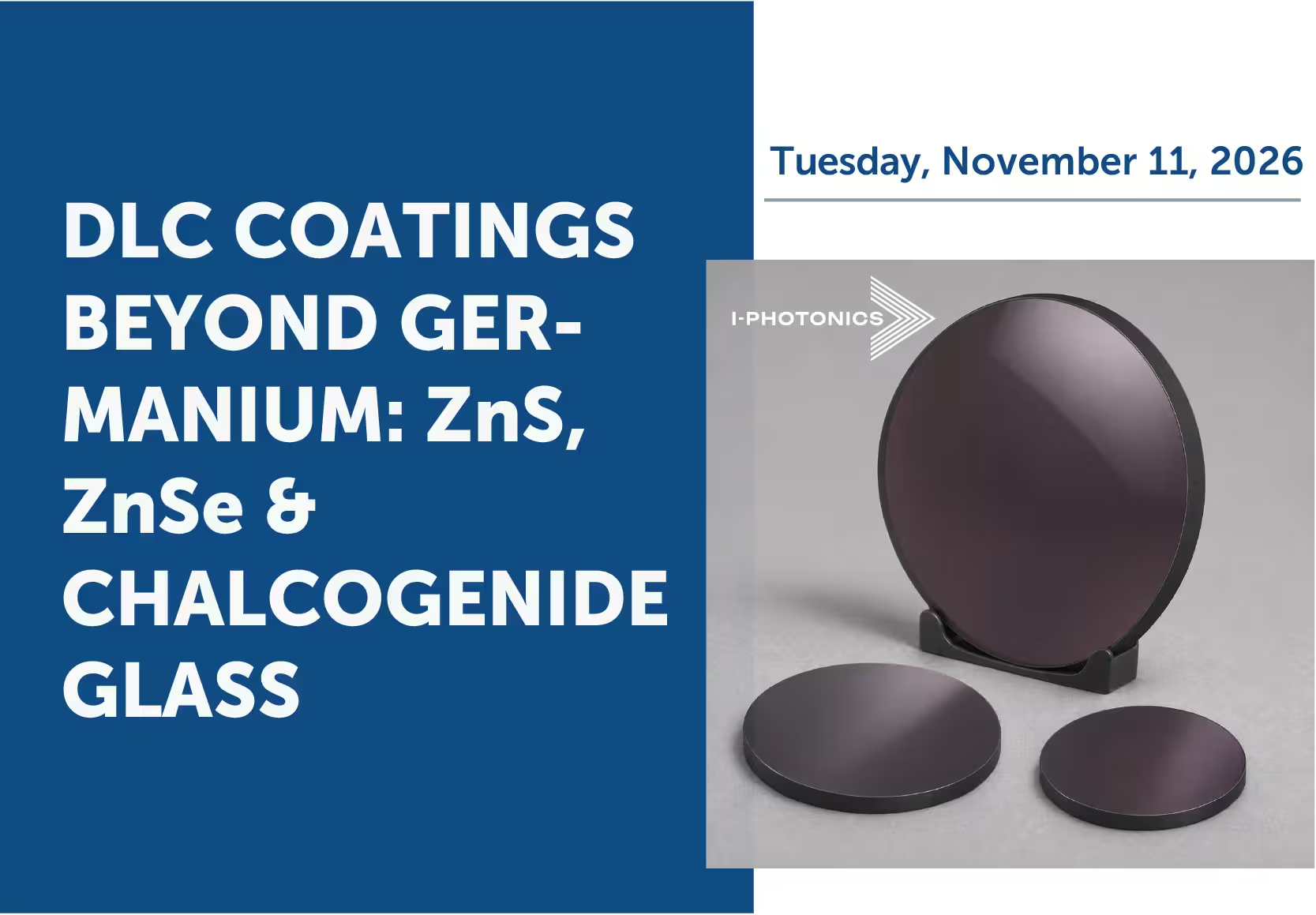
What does it take to put a diamond-like carbon coating on a chalcogenide glass lens, not just on germanium?
The front lens of a thermal camera takes everything the environment throws at it: sand, rain, wipers, cleaning agents. DLC has long been the standard protective AR coating for these surfaces, but mostly on germanium and silicon. Meanwhile, IR lens designers are moving towards ZnS, ZnSe and moldable chalcogenide glasses, and each of them reacts to a DLC process in its own way.
With the DIAMANTA ion-beam PECVD system, we now coat five IR substrate types on one platform: Si, Ge, ZnS, ZnSe and chalcogenide glass. The system delivers AR performance in the 3–5 µm and 7–14 µm ranges, thickness uniformity of ±3% across 330 × 350 mm, and a 2.5-hour cycle for MWIR DLC coatings.
Why Substrate Matters
The quality of a DLC coating depends heavily on what it is deposited on. Adhesion, intrinsic stress and the thermal budget of the process must all match the substrate:
- Germanium and silicon form a strong bond with carbon and tolerate the process well.
- ZnS and ZnSe require careful interface engineering to achieve reliable adhesion under environmental testing.
- Chalcogenide glasses are sensitive to process temperature and differ in composition from one manufacturer to another, so the process window has to be adapted for each glass type.
For this reason, I-Photonics develops process technologies for each optical material separately, rather than offering a single universal recipe.
DIAMANTA: Ion-Beam PECVD for IR Optics
The DIAMANTA vacuum system deposits DLC by plasma-enhanced chemical vapor deposition: carbon is deposited from the gas phase, with the reaction stimulated by the plasma of an ion beam source. The resulting coatings are anti-reflective in the 3–5 µm (MWIR) and 7–14 µm (LWIR) ranges.
One platform covers the full set of common IR substrates:
- Silicon
- Germanium
- ZnS
- ZnSe
- Chalcogenide glasses from different manufacturers
I-Photonics offers hybrid AR + DLC coatings for ZnS, ZnSe and chalcogenide glass substrates using a two-step process that combines ion-assisted deposition (IAD) with plasma-enhanced chemical vapor deposition (PECVD). First, the AR layers are deposited by IAD to promote reliable adhesion and improve optical performance. A DLC top layer is then applied by PECVD to provide protection in harsh environments. This approach combines the optical performance of the AR stack with the durability of the protective DLC layer and is particularly suited to exposed lens and window surfaces.
For our Ge and Si DLC processes, the coating can be deposited directly on the prepared substrate without separate adhesion underlayers.
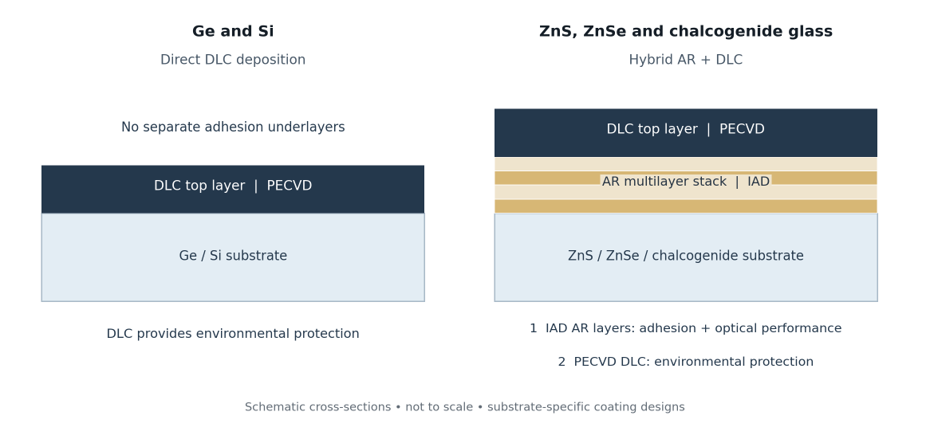
Coating sequence comparison. Ge and Si receive DLC directly; ZnS, ZnSe and chalcogenide glass use IAD AR layers before the PECVD DLC top layer.
Our low-temperature process keeps residual stress low and produces pinhole-free, uniform layers. This is the result of years of process development on IR substrates.
Our PECVD DLC layers can also be applied to curved substrates, just like IAD AR layers. This makes the hybrid AR + DLC solution from I-Photonics well suited to lenses as well as flat windows.
DIAMANTA DLC System Parameters
- Deposition area: 370 × 420 mm
- Maximum substrate thickness: 45 mm
- Coating thickness uniformity: ≤ ±3% across 330 × 350 mm
- Base pressure: 3×10⁻³ Pa within 15 min after loading
- Deposition cycle: 2.5 h for MWIR DLC coatings; under 8 h for a full coating cycle
From Trial Coating to In-House Production
DIAMANTA is delivered together with the process. Customers purchase the coater, and I-Photonics develops and transfers the DLC and AR process tuned to their substrates and their application. The path runs from trial coating and validation on the customer’s own materials to stable in-house production.
Typical applications include night vision devices, thermal imagers, IR sensors, pyrometers, camera lenses and objectives, and R&D.
Which substrate is giving you trouble?
Adhesion on ZnS? Thermal limits of a specific chalcogenide glass? Combining a broadband AR stack with a durable outer layer? Tell us in the comments which IR material is the hardest to protect in your production.
If you are considering bringing DLC coating in-house, our engineers can run a trial coating on your own substrates.
Discuss your substrate with an engineer
About I-Photonics
I-Photonics has extensive experience in ion-beam technology and thin-film physics. Our team brings decades of R&D in precision optical coatings and in developing hardware that extends the capabilities of existing coating technologies. Building on a broad portfolio of coating equipment and processes, I-Photonics offers competitive turnkey equipment and coating solutions for a wide range of applications.
I-Photonics UAB, Vilnius, Lithuania
DLC Coatings for ZnS, ZnSe & Chalcogenides | I-Photonics Blog
Read more

High-Performance Narrowband Optical Filters: Precision Thin-Film Coatings for Demanding Applications
Narrowband optical filters isolate a precisely defined wavelength band from a much broader optical background, delivering higher signal-to-noise ratios and selective detection of weak optical signals. In this edition we show how I-Photonics engineers complex PARMS interference coatings — over one hundred dielectric layers — and demonstrate an astronomy-grade [S II] narrowband filter near 673.1 nm with 93.89% peak transmission and a ~3.1 nm FWHM.
Narrowband Optical Filters: Precision Thin-Film Coatings | I-Photonics Blog

When Every ppm Matters: The Science Behind Low Absorption Optical Coatings
At the frontier of high-power lasers and gravitational wave detection, optical losses are now measured in ppm. We explore how electric field engineering and thermal relaxation push IBS thin films into the single-digit ppm absorption regime, enabling HR mirrors with reflectance up to 99.9966%.
When Every ppm Matters: The Science Behind Low Absorption Optical Coatings | I-Photonics Blog
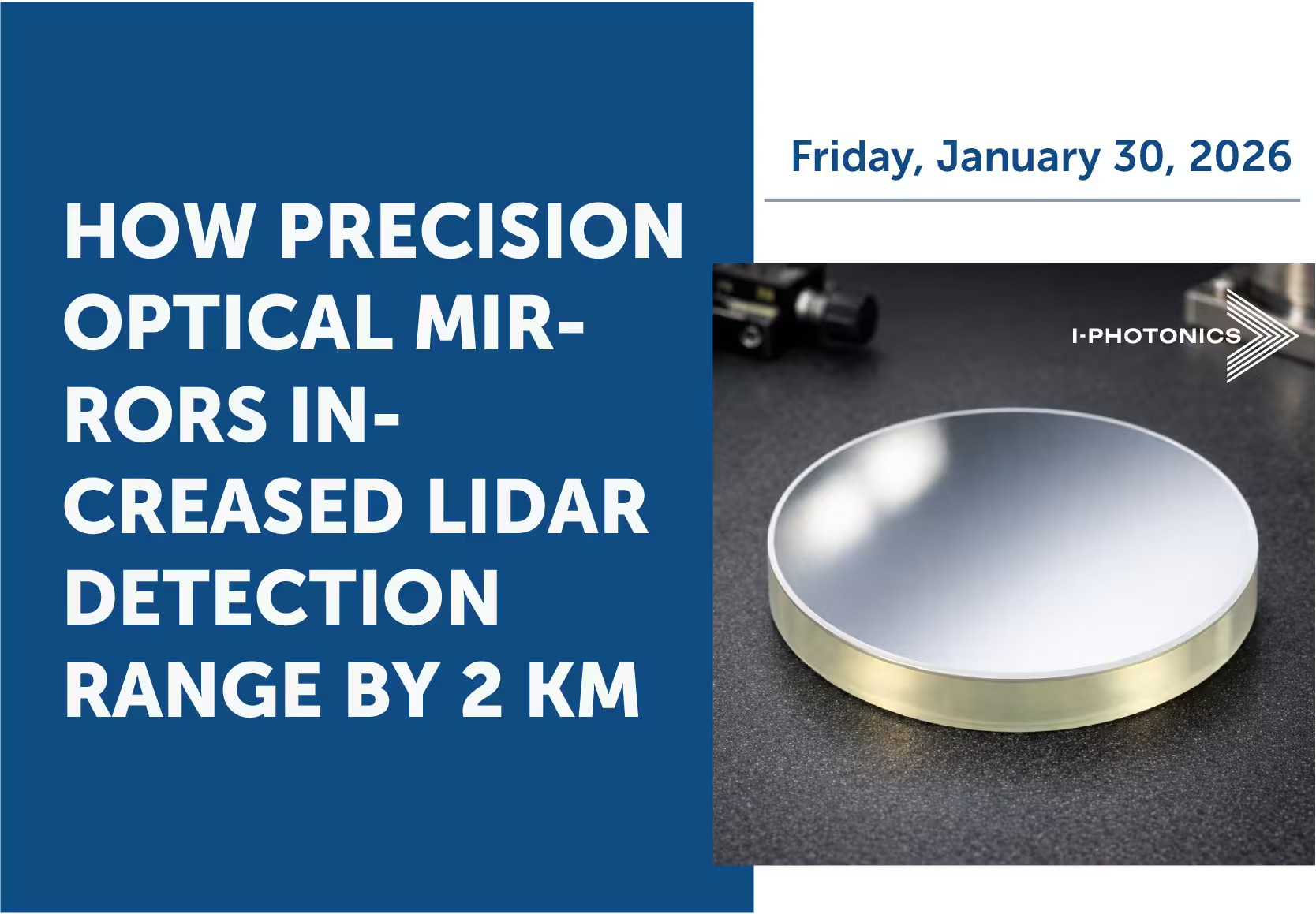
How Precision Optical Mirrors Increased LiDAR Detection Range by 2 km
How precision optics boosts 1550 nm LiDAR range and signal fidelity — a real 13% system improvement case study.